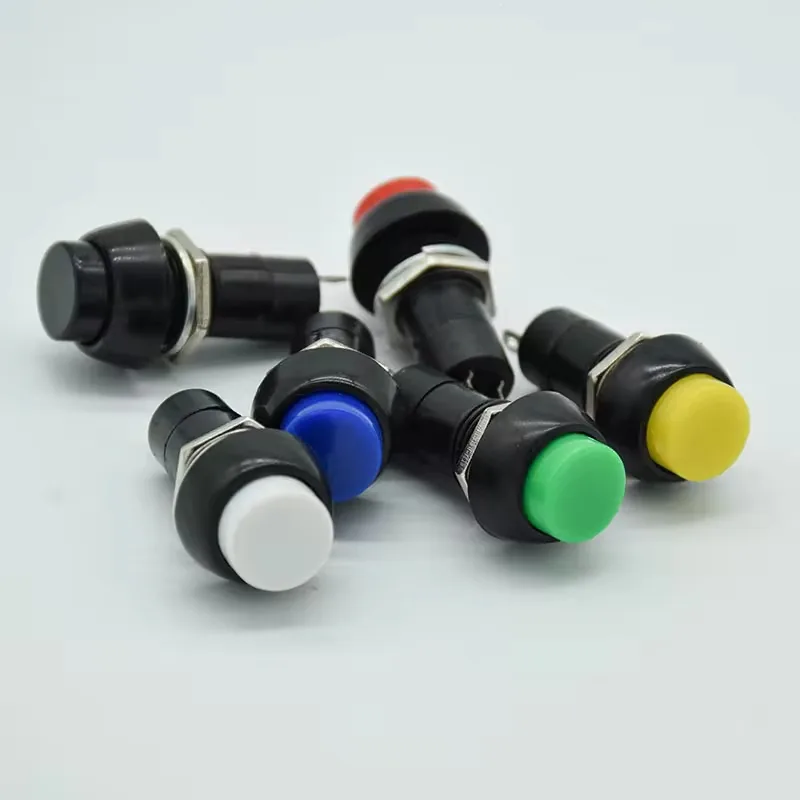
Basic Definition and Working Mechanism of Push Button Switch
A push button switch is a common manual control electronic component that realizes circuit connection and disconnection through vertical pressing and rebounding actions. Most push button switch models adopt spring reset structure. When pressed manually, the internal contacts close or open to change the circuit state; when the external force disappears, the spring drives the button to reset, restoring the original circuit state. This simple and efficient working mode makes push button switch widely used in consumer electronics, industrial control equipment, household appliances and automotive electrical systems.
Push button switch products are mainly divided into momentary type and latching type. Momentary push button switch only keeps the on state during pressing and automatically turns off after release, which is suitable for instantaneous signal output. Latching push button switch can lock the circuit state after one press and complete state switching again through secondary pressing, meeting the needs of long-term power on and off control.
Structural Characteristics and Working Logic of Rocker Switch
Different from the linear pressing mode of push button switch, rocker switch controls the circuit through the swing and flipping of the rocker arm. The internal structure of rocker switch relies on the mechanical transmission of the seesaw principle. The left and right or up and down swinging of the rocker drives the contact piece to switch between different contact points, realizing stable circuit on and off or gear switching.
Rocker switch mostly adopts self-locking structure without automatic reset function. Once the gear position is switched, it can maintain a stable working state for a long time. This structural feature makes rocker switch more suitable for long-term power control scenarios, such as household power sockets, lighting equipment, industrial power distribution boxes and vehicle power systems.
Core Functional Differences Between Two Mainstream Switches
In terms of operation logic, push button switch focuses on instantaneous control and flexible state switching, while rocker switch focuses on stable locking and continuous power control. The operation stroke of push button switch is short with sensitive response, which is suitable for precise signal triggering and frequent instantaneous operation. The swing stroke of rocker switch is clear with obvious gear sense, which is not easy to cause accidental touch and has higher operational stability.
In terms of structural durability, both push button switch and rocker switch can meet long-term industrial use standards, but their applicable scenarios are different. Push button switch is more inclined to low-current signal control, while high-current rocker switch can bear higher load current and is more suitable for main circuit power switching. Understanding the essential differences between push button switch and rocker switch is the basis for scientific model selection in electronic design and equipment assembly.