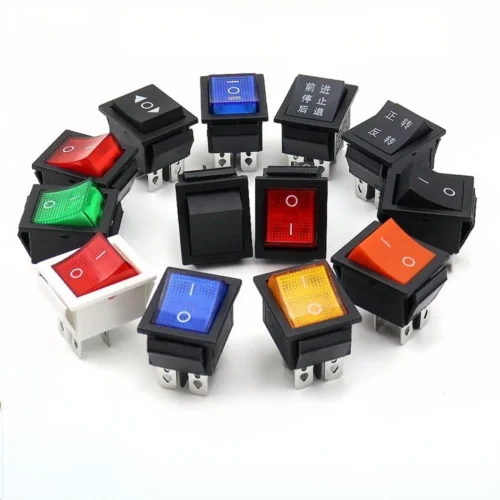
Rocker switches are standard components for mass‑production OEM household appliances, power equipment and consumer electronics. Improper sourcing will lead to product rework, return complaints and safety risks. OEM buyers and hardware engineers need to focus on multiple key points.
Step 1: Confirm Complete Technical Specifications
Before requesting quotation or samples, sort out full parameters:
- Rated current & voltage (AC or DC)
- Pole‑throw type: SPST, SPDT, DPST, DPDT
- Panel cutout dimension, pin type and pin pitch
- With or without indicator light; light color requirement
- Waterproof protection grade (IP rating)
- Mechanical life requirement
- Operating temperature range
Missing any parameter will cause sample mismatch and delay project progress.
Step 2: Sample Evaluation Is Indispensable
Do not place large‑batch orders directly without sample validation. Test items for rocker switch samples:
- Appearance and dimension check, verify panel mounting fit.
- Multimeter test electrical continuity for ON/OFF gear.
- Toggle thousands of times to test mechanical hand‑feel and fatigue performance.
- Load test under actual working current, check heating and contact stability.
- For illuminated models, inspect indicator lamp stability.
Step 3: Pay Attention To Batch Consistency
For OEM mass production, batch‑to‑batch consistency is critical. Focus on contact alloy material, plastic flame‑retardant grade. Low‑cost suppliers may switch raw materials between batches, leading to hidden safety hazards. Confirm flame retardant rating for products working under high‑temperature condition.
Step4: Avoid Typical Sourcing Pitfalls
- Only focus on unit price while ignoring rated parameter margin. Leave enough current margin for real working load.
- Neglect environmental adaptability. Devices working in damp workshop need IP waterproof rocker switches. Ordinary models will fail quickly.
- Ignore pin compatibility. Wrong pin layout cannot match PCB or wiring harness.
Rocker switches look simple, yet they are power‑related safety components. Qualified suppliers should provide specification datasheets and support customized OEM requirements for housing color, lamp color and logo printing.