Blog
Micro Switch Cost Control Without Sacrificing Reliability

Micro Switch Cost Control Without Sacrificing Reliability
When engineers talk about micro switch cost control, the real goal is rarely “buy the cheapest part.” It is about paying only for the performance you actually use, while protecting the product against the hidden cost of early failure. The smartest savings come from matching the switch precisely to the duty, then looking at the whole life cycle instead of the sticker price. This article walks through three practical dimensions that keep total cost down without compromising reliability.
1. Match the Basics to Avoid Over-Specification
The fastest way to overspend is to specify a premium feature you will never need. Start with the environment. If the device lives in a dry, clean indoor space such as a household appliance or office equipment, a standard non-sealed switch is the right answer. Sealed IP67 or IP68 versions cost far more and add nothing when there is no moisture or dust to keep out. Reserve the sealed build for the applications that genuinely demand it.
Contact configuration is the next lever. A circuit that only needs a simple on or off action is perfectly served by a two-terminal, single-pole single-throw (SPST) switch. Its structure is simpler and its price is lower. Only move to a three-terminal single-pole double-throw (SPDT) part when the design truly requires linked contacts or simultaneous monitoring of normally open and normally closed states. Paying for poles you do not use is pure waste.
Contact material follows the same logic. Low-current signal loops such as sensor triggers or control-board inputs do not need expensive gold. Ordinary silver or copper contacts deliver the performance required at a fraction of the cost. Reserve gold-plated or silver-alloy contacts for precision instruments that demand low contact resistance or for high-current paths where arc resistance matters. Right-sizing the material prevents “over-qualifying” the part.
Finally, size and operating force should fit the mechanism, not the brochure. Within the space the enclosure allows, there is no benefit in chasing the smallest or the largest body. More importantly, the operating force must match the actuator: too high accelerates wear on the driving mechanism, too low invites false triggering and repeated replacements. Both extremes create hidden cost through premature swapping.
2. Right-Size Lifespan and Load to Avoid Over-Engineering
Life rating and price move together, so the second dimension is choosing the endurance you can justify. A low-frequency operation, such as a drawer limit or an appliance button, is well served by a standard mechanical life of around 100,000 cycles. Paying a premium for a million-cycle part in that context is money spent for capacity that never gets used. By contrast, a high-frequency line, such as industrial automation or high-speed inspection, must use a long-life switch; here the saving is on the other side, because a cheap part that fails early stops the production line and costs far more than the premium.
Load evaluation is the companion to lifespan. Calculate the actual operating current and voltage accurately, then apply a sensible margin, and remember that inductive loads such as motors and solenoids require derating. The trap is to over-select: specifying a switch rated for far higher current or voltage than the circuit needs inflates procurement cost for no functional gain. The equal and opposite trap is to under-rate, which burns the switch and triggers repair cost. The sweet spot is an honest rating with a modest, deliberate margin.
3. Optimize Sourcing and the Supply Chain
The third dimension steps back from the part itself to how you buy it. For prototype runs or service spares, work with suppliers that accept low minimum order quantities and support small-batch customization, so capital is not tied up in inventory you cannot use. For volume production, scale the order and engage directly with the source factory to capture a better unit price. Matching order size to the phase of the project is a direct cost lever.
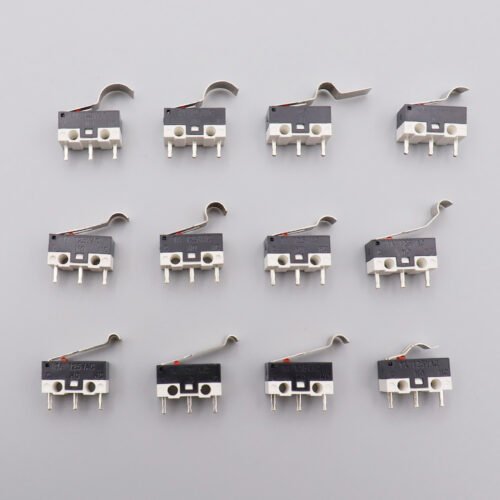
Just as important is judging value instead of price alone. A part with a slightly higher unit cost but stable quality, low failure rate and responsive after-sales support usually wins on total cost, because it suppresses warranty claims, field repairs and downtime. The reliable, well-supported switch is often the cheaper one once the whole life cycle is counted. To compare certified, in-stock models side by side, you can browse our full micro switch catalog or explore the micro switch product category and shortlist cost-effective candidates for your build.
Conclusion
Effective cost control is not about cutting corners; it is about disciplined matching. Specify the protection, poles, material, size, life and load that the application truly needs, then buy at the right volume from a dependable source. Done well, this approach lowers both the purchase price and the hidden costs of failure, giving you a cost-effective micro switch solution that holds up in the field.