Blog
Ultimate Micro Switch Selection Guide: Avoid 5 Mistakes

Selecting the right micro switch matters far more than its low price suggests. A wrong choice can disable safety interlocks, burn out contacts, or fail limit positioning—costs that dwarf the switch itself. This micro switch selection guide breaks down the five most critical parameter mistakes engineers and buyers make, and how to avoid them.
Why Correct Micro Switch Selection Matters for Equipment Stability
Most purchasers underestimate how much a micro switch affects overall equipment performance. These miniature snap-action switches handle signal triggering, limit positioning, and safety interlock protection. A mismatched unit reduces sensitivity, causes recurring faults, and creates safety risks over time.
In practice, many debugging failures trace back to incorrect parameter matching rather than circuit or structural flaws. Standardizing your selection criteria prevents avoidable losses. Before specifying, compare rated values in our complete micro switch catalog so the part fits both the load and the environment.
Mistake 1 — Focusing Only on Size, Ignoring Operating Force (OF)
The most common error is judging compatibility by appearance alone. Buyers match outer dimensions to an old sample and ignore operating force, which controls triggering sensitivity.
Micro switches rely on internal spring deformation to switch. Operating force ranges from tens to hundreds of grams and splits into three bands: light-touch (15–50 g) for precision electronics and mouse keys, standard (100–200 g) for appliances and toys, and heavy-load (250 g+) for industrial and automotive use.
A mismatch is obvious in use. Replacing an 80 g light-touch switch with a 200 g unit under a plastic key makes the button hard to press, so users assume the device is broken. Always confirm the exact operating force in gf or N, and choose light-touch types for low-force triggering.
Mistake 2 — Neglecting Current Rating and Load Type
Using one switch for every load is a leading cause of early burnout. Contact capacity falls into two clear groups, and crossing them causes irreversible damage.
Weak-signal switches (5 mA–50 mA) serve low-current board signals and sensors. Power-grade switches (2 A–15 A) drive motors, indicators, and heaters. The classic misuse is putting a weak-signal switch on a motor: inrush current burns the contacts black within a few cycles.
Remember, rated current is the value that guarantees long life, not the maximum the part can survive. For inductive loads such as motors and solenoids, apply a 1.5× or higher derating margin. Industrial buyers should look for 16 A 250 VAC parts with UL and ENEC certification.
Mistake 3 — Overlooking IP Protection Grade
Outdoor, kitchen, bathroom, and woodworking equipment often fails after a few months because ordinary unsealed switches let in dust and vapor. Internal contacts and springs then corrode.
IP40 models suit clean, dry indoor air. IP54 resists splashes and floating dust in kitchens and bathrooms. IP67 fully sealed units block dust and survive short immersion—ideal for outdoor, automotive, and woodworking environments. High-quality sealed switches use epoxy potting to protect the internals; match the grade to your humidity, dust, and water exposure.
Mistake 4 — Ignoring Mechanical Lifespan for High-Frequency Use
Mechanical life spans a huge range, from 100,000 to 10 million cycles. Teams often assume the switch is maintenance-free and ignore frequency matching, so high-cycle positions wear out fast.
A vending-machine door limit switch acting dozens of times a day can last seven or eight years. A feeder counter running thousands of cycles daily will kill a short-life part in months. Current and temperature accelerate fatigue further. For continuous cycling, prioritize long-life models—standard units offer 1 million cycles, with upgraded versions reaching 5 million.
Mistake 5 — Ignoring Installation and Actuation Method
Actuation and mounting mismatches cause failed, premature, or delayed triggering. Micro switches offer several actuator structures for different strokes and drives.
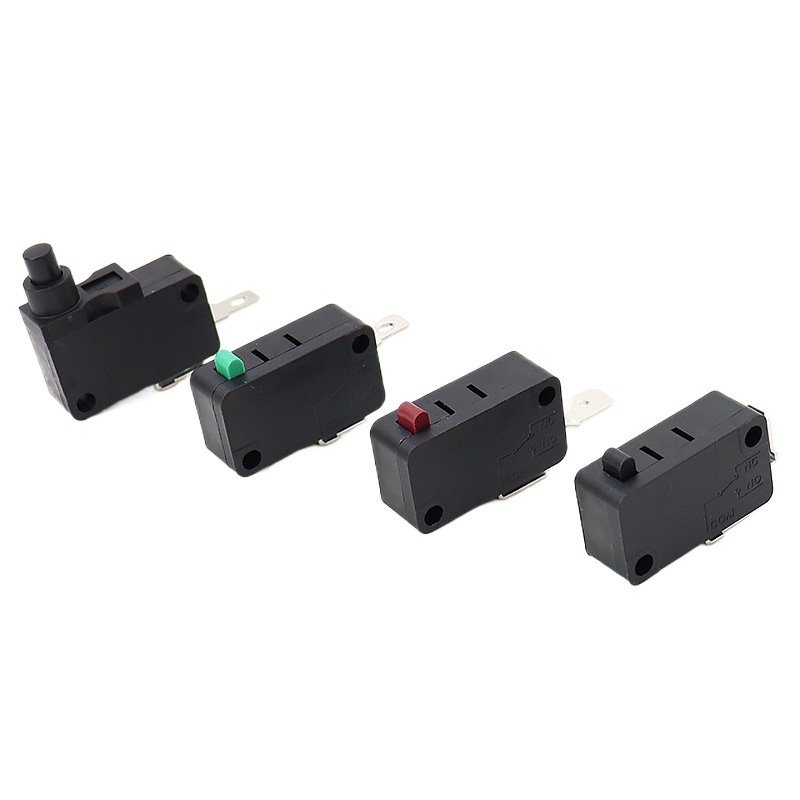
The pin-button type suits direct vertical pressing. The roller-lever type pairs with cams and slides to lower friction. The long-lever type amplifies stroke for large mechanical movement. A real failure case: a cam with only 0.5 mm travel mated to a 1.5 mm long-lever switch never actuates, so the signal stays dead. Always specify the driving object, contact angle, and effective stroke so the supplier matches the right actuator head.
Final Selection Summary
Accurate selection means matching five parameters: operating force to sensitivity, current rating to load type, IP grade to environment, mechanical life to frequency, and actuation method to stroke. Avoid these five mistakes and you eliminate insensitive action, contact burnout, dust and water failure, short life, and invalid triggering.
For a side-by-side look at ratings and actuator options, browse our full range of micro switches for sale and shortlist candidates by your application.
FAQ
What is the most important parameter for micro switch selection?
Operating force, current rating, and protection grade are the three core parameters. Wrong force causes insensitive triggering, wrong current burns contacts, and weak protection leads to environmental failure.
What is the difference between weak-signal and power micro switches?
Weak-signal switches handle low-current signals; power-grade switches drive motors and heaters. They cannot be used interchangeably.
Which IP grade is suitable for outdoor use?
IP67 fully sealed micro switches are best outdoors, with full dust protection and short-term waterproof immersion.
How do I choose a micro switch for high-frequency operation?
Prioritize long-life models rated over 1 million cycles, and apply proper current derating to slow mechanical and electrical fatigue.
How do I choose the right actuation type?
Match it to the stroke and drive: button type for direct pressing, roller type for cam sliding, and long lever for large-stroke movement.