Blog
Micro Switch Working Principle & Application Guide

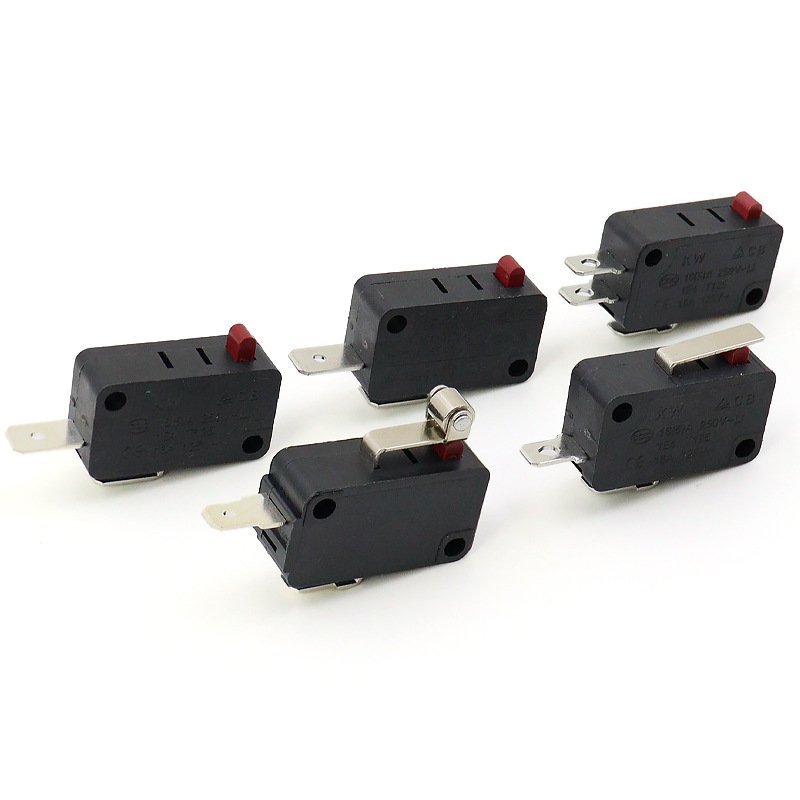
Micro switches—also called miniature snap-action switches—are among the most widely used electronic components in modern devices. This guide explains the micro switch working principle, the three main switch types, how to test a faulty unit with a multimeter, and where these compact switches are used across home appliances and industry.
Core Working Principle of a Standard Micro Switch
Every micro switch relies on the same core mechanism: a precise snap-action contact system. Unlike ordinary mechanical switches that need a long travel distance, a micro switch changes state with a very short trigger stroke and only light external pressure.
Inside, a high-precision movable contact, a fixed contact, and an elastic spring hold the circuit in a stable state. When the actuator is pressed, the spring deforms instantly and drives the movable contact to either connect or separate from the fixed contact. Once the force is released, the spring resets automatically. This rapid snap-action design is what lets a micro switch survive millions of cycles.
Choosing the right model starts with understanding the rated load, actuator shape, and environment. You can compare specifications in our complete micro switch catalog before finalizing your design.
Three Main Types of Micro Switches
Micro switches are divided by their circuit behavior into three groups. Each fits different control and safety needs.
Normally Open (NO) Micro Switch
A normally open micro switch keeps the circuit disconnected until it is pressed. The movable contact stays apart from the fixed contact, so the circuit is off by default. Only when the actuator reaches the trigger point do the contacts close and turn the circuit on. This two-terminal type is common in start triggers and signal activation.
Normally Closed (NC) Micro Switch
A normally closed micro switch is the opposite. Its contacts stay tightly connected, so the circuit conducts in the natural state. When the actuator is pressed, the circuit opens immediately. Because it cuts power on activation, it is widely used for safety interlocks and emergency stop control.
Changeover Micro Switch
A changeover micro switch supports two-way single-circuit switching. One circuit is always conducting before and after actuation, and the two circuits never close at the same time. In practice, it can replace either an NO or an NC switch, giving designers more flexibility.
How to Test a Micro Switch (Detection & Failure Judgment)
Because a micro switch often handles signal control and safety, regular testing prevents equipment failure. The standard tool is a multimeter.
Measure continuity across the terminals before and after pressing the actuator. A healthy switch shows a single, clear state change—one circuit conducts in either the rest or pressed state. If the multimeter shows both circuits conducting at once, or no change at all, the switch is damaged and should be replaced.
Most failures come from spring fatigue, contact oxidation, or mechanical jamming. Timely inspection avoids both downtime and safety risks.
Where Micro Switches Are Used
Thanks to their small size, high sensitivity, and long life, micro switches appear in almost every industry. Below are the most common scenarios.
Home Appliance Applications
Micro switches are core control parts in washing machines, microwave ovens, rice cookers, and refrigerators. They manage start-stop control, door interlocks, and mode switching. For example, a microwave door switch cuts the heating circuit the moment the door opens, preventing radiation leakage.
Computer & Consumer Electronics
In consumer devices, micro switches deliver precise manual input. The clearest example is the computer mouse button, where high-end switches offer a trigger stroke as short as 0.4 mm. They also appear in keyboard keys, phone power buttons, and router controls.
Automotive & New Energy Industry
Automotive systems depend on micro switches for position detection and function control—window lift, seat adjustment, and brake-state monitoring. In new energy vehicles, they take on critical roles such as charging-gun insertion detection and charging-pile status monitoring.
Industrial Automation & Special Equipment
In factories, micro switches work as limit switches and position sensors. They guard robotic-arm positioning, safety-door limits, and production-line control, helping avoid collisions and operational errors in harsh environments.
Medical Devices, Security & Aerospace
For high-reliability fields, micro switches sit inside ventilators, patient monitors, and diagnostic equipment. They also trigger alarms in anti-theft and smoke systems, and support rail transit and aerospace controls where failure is not an option.
To match the right part to each application, browse our full range of micro switches for sale covering NO, NC, and changeover variants.
Key Design Considerations When Selecting a Micro Switch
Although the working principle is simple, real-world performance depends on structure and materials. Engineers should weigh operating temperature, electrical load, actuator characteristics, and rated service life together. Good selection and installation maximize control accuracy and reduce later maintenance.
Conclusion
As essential yet basic components, micro switches turn mechanical motion into precise electrical signals through a mature snap-action principle. The NO, NC, and changeover types meet different control needs, while their compact size and long durability support uses from home appliances to aerospace. Mastering the micro switch working principle, its types, and its testing method is the key to reliable application.
FAQ
What are the three types of common micro switches?
Standard micro switches are normally open (NO), normally closed (NC), and changeover. NO closes when pressed, NC opens when pressed, and changeover supports two-way single-circuit switching.
How do I test if a micro switch is damaged?
Use a multimeter to check terminal continuity before and after pressing. A good switch shows one clear state change; simultaneous conduction or a permanent open circuit means it is damaged.
What are the main applications of micro switches?
They are used in home appliances, computer peripherals, automotive electronics, industrial automation, medical devices, and safety alarm systems for position detection and signal triggering.
What is the advantage of a changeover micro switch?
It can replace both NO and NC switches, supports two-way circuit control, and prevents simultaneous conduction of dual loads, giving broader design compatibility.