Blog
Rocker Switch Material Comparison: Quality and Performance Differences

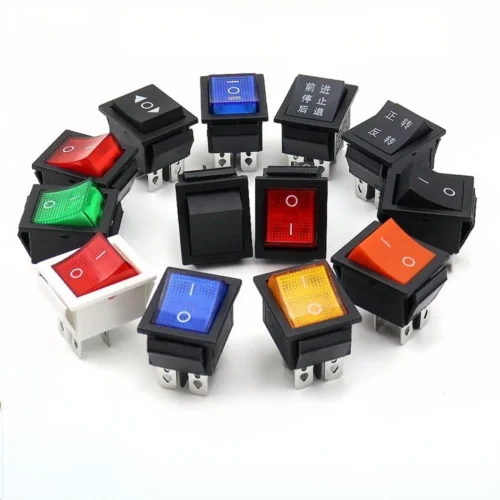
Rocker switches (boat switches) are widely used in household appliances, industrial equipment, and power control systems. In practice, different manufacturers adopt different raw materials based on application requirements and cost budgets. The internal and external materials directly determine conductivity, heat resistance, wear resistance, and insulation performance. They also decide the overall service life. Therefore, comparing rocker switch materials is the most effective way to distinguish high-quality products from low-grade ones.
This guide provides a detailed rocker switch material comparison. It covers conductive copper sheets, panel materials, base materials, button lever materials, and contact materials. So it helps buyers and engineers select the most suitable rocker switch for different electrical scenarios.
1. Conductive Copper Sheet Material Comparison
The internal current-carrying copper sheet is the core conductive part of a rocker switch. Its hardness, elasticity, and conductivity directly affect current load capacity and switching stability.
Brass
This material features high hardness and medium conductivity. It also has a bright yellow appearance. However, its elasticity is relatively weak. So manufacturers commonly use it in low-current and low-cost standard rocker switches for ordinary household appliances.
Tin Phosphor Bronze
In contrast, tin phosphor bronze delivers hard texture, excellent elasticity, and better conductivity than brass. It has a reddish-yellow color and maintains stable mechanical performance after millions of clicks. Therefore, it is the mainstream material for mid-to-high grade rocker switches.
Red Copper
Finally, red copper has a slightly soft texture, outstanding elasticity, and the highest conductivity among the three. Its purplish-red appearance ensures ultra-low current loss. So it is ideal for high-current, high-precision, and long-life industrial rocker switches.
2. Rocker Switch Panel Material Comparison
The outer panel determines the switch’s wear resistance, heat resistance, impact resistance, and appearance durability.
ABS Plastic
First, ABS is a low-grade engineering plastic. It has low structural strength and poor heat resistance. In addition, it is prone to yellowing and deformation after long-term use. So it usually appears in low-cost civilian-grade switches.
PC Material
In contrast, PC polycarbonate material provides strong impact resistance, excellent heat resistance, and high light transmittance. It resists deformation under high temperature and maintains a smooth appearance for a long time. Therefore, manufacturers widely use it in medium and high-quality rocker switches.
Urea Formaldehyde Plastic (Electric Jade Powder)
Finally, electric jade powder is a high-grade thermosetting material with permanent flame retardancy, discoloration resistance, and wear resistance. It features stable thermal chemical performance and never fades or wears out. Thus it is the best panel material for high-end industrial and household rocker switches.
3. Rocker Switch Base Material Comparison
The switch base supports internal structural parts and guarantees insulation safety and high-temperature stability.
Imported Reinforced Nylon
First, imported reinforced nylon offers excellent insulation, high rigidity, strong impact resistance, and corrosion resistance. It does not deform under high temperatures. Also, it firmly fixes internal components without loosening or falling off. So it is the most reliable base material for high-quality rocker switches.
Recycled PC Material
In contrast, recycled PC material has weak impact resistance and poor heat resistance. It is easy to deform under high temperature and long-term load. As a result, this may cause structural loosening and poor contact.
Ordinary Synthetic Plastic
Finally, ordinary plastic ages quickly, has poor flame retardancy, and deforms easily. So it only suits low-frequency and low-standard cheap switches with short service life.
4. Rocker Switch Button Lever Material
The button lever (toggle nozzle) affects pressing smoothness, friction loss, and long-term operating stability.
Self-Lubricating Nylon Material
First, self-lubricating nylon is hard and wear-resistant. It also has built-in lubricating properties. So it effectively reduces friction during frequent pressing. This ensures smooth operation. It also avoids high-temperature ablation of internal silver contacts.
Ordinary Reinforced Nylon
In contrast, ordinary reinforced nylon gradually increases friction after long-term use. So it causes a stiff and stuck pressing feeling. In addition, excessive friction generates heat, which melts silver contacts. This reduces the switch’s current-carrying capacity and service life.
5. Rocker Switch Contact Material Comparison
Contacts are the core conductive components that decide conduction stability and anti-arc performance.